



Most buyers start the same way. A shopping mall landlord offers you 12 square metres next to the cinema entrance, or you are filling a dead corner of a family entertainment center, and the claw machine is the obvious first purchase. It is compact, it needs no attendant, and it earns while the rest of the venue is quiet.
Then the sourcing begins, and the search results all look identical. Hundreds of Chinese suppliers claim to be "the leading manufacturer," with the same stock photos and the same vague promises. This guide is written for buyers who want to tell the difference — the specifications that actually affect uptime, the certifications that determine whether your machine can legally run, and the cost structure behind a quotation that looks suspiciously cheap.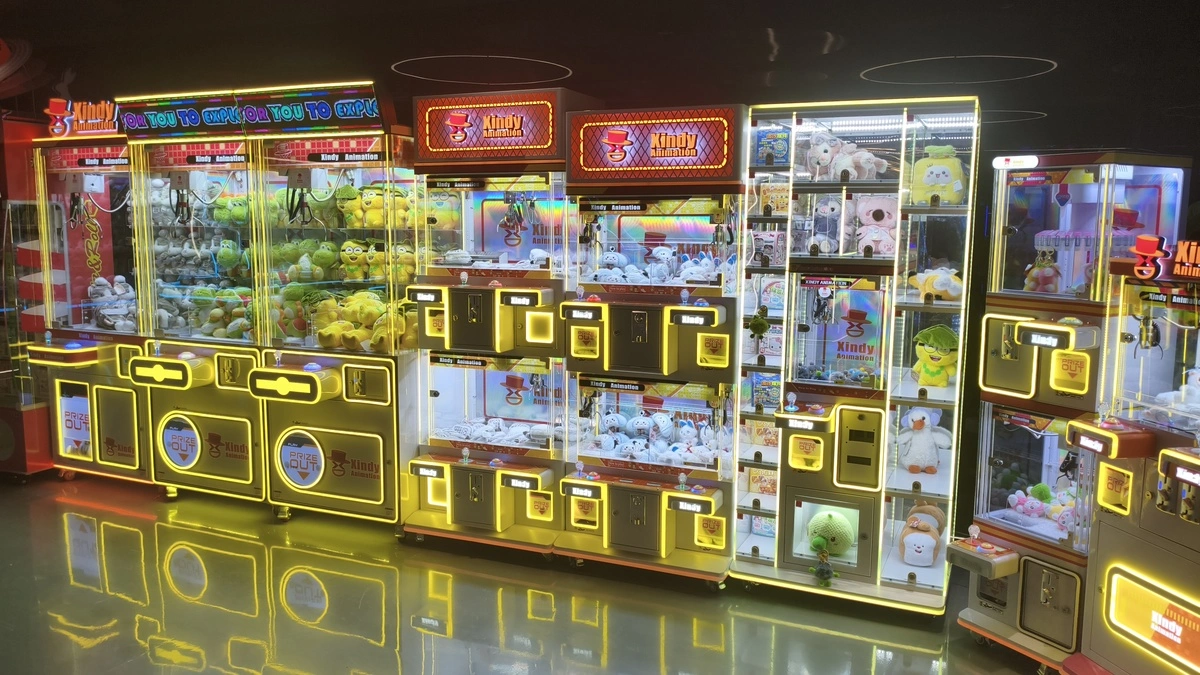
Why Source Commercial Claw Machines from China?
China dominates this category for a reason that has nothing to do with cheap labor. The Pearl River Delta — Guangzhou and Panyu in particular — hosts a dense cluster of amusement equipment factories, sheet metal shops, acrylic and LED suppliers, and control-board makers within a short drive of each other. A cabinet, a harness and a prize chute can be prototyped in days, not months.
For a buyer, that ecosystem delivers three practical advantages:
- Breadth of catalog. One factory can usually supply standard crane cabinets, mini units for tight spaces, large-format prize machines, and themed builds with custom lighting and branding.
- Customization economics. Cabinet wraps, marquee artwork, logo molding and software rebranding are cheap when the supply chain sits next door. In Europe or North America, the same changes cost several times more.
- Consolidation. If you are also buying VR simulators, racing cabinets, basketball or boxing machines, a single Guangzhou partner can load them into one container and ship under one invoice.
The trade-off is diligence. Distance hides a lot, so the rest of this guide focuses on what to verify before you pay a deposit.
Types of Commercial Claw Machines
| Type | Footprint | Typical use | Notes for buyers |
|---|---|---|---|
| Standard crane cabinet | 0.8–1.2 m² | Malls, FECs, cinema lobbies | The workhorse. Predictable prize flow and easy service access. |
| Mini / countertop | 0.3–0.5 m² | Restaurants, hotel lobbies, queues | Lower price per play. Ideal where floor space is limited. |
| Large prize / giant claw | 1.5–3 m² | Flagship attractions, photo moments | Higher capex, longer dwell time. Check ceiling height first. |
| Multi-player bank | 2–4 m² | Arcade rows, busy corridors | Cabinets share one service corridor. Plan wiring early. |
| Themed or licensed build | Custom | Brand activations, IP partnerships | Longest lead time. Artwork and licensing gate production. |
Match the machine to the queue, not to the catalog. A cinema lobby has twenty minutes of captive dwell time and rewards a larger, brighter cabinet. A restaurant entry rewards a mini unit that does not block the host stand.
Specifications That Actually Matter
Marketing sheets list dozens of parameters. These are the ones that change your operating cost or your downtime.
| Spec | Why it matters | What to ask |
|---|---|---|
| Claw strength control | Sets the win rate, and therefore your margin | Can grab strength be adjusted in software, per prize weight, without opening the cabinet? |
| Prize payout logic | Controls how often a win is permitted | Can you set payout by time window or by plays? Is it logged? |
| Payment systems | Revenue capture | Coin, bill acceptor, card/NFC or QR code — and which are certified for your market? |
| Cabinet build | Survival in public spaces | Steel frame gauge, tempered glass thickness, lock quality, anti-tip base |
| Service access | Repair time | Can one technician replace the claw motor or control board in under 30 minutes? |
| Telemetry | Management at scale | Remote monitoring of plays, revenue and fault codes across multiple units |
| Power | Compliance and running cost | Voltage and frequency for your country, power draw, surge protection |
| Prize capacity | Restocking labour | How many prizes fit, and how long does a refill take? |
Ask for the service manual, not just the brochure. A supplier who cannot produce an exploded parts diagram will cost you weeks the first time a motor fails.
Compliance and Certifications
This is where cheap quotations become expensive. A machine that cannot be legally plugged in is inventory, not equipment.
- European Union: CE marking, supported by a declaration of conformity and test reports (machinery safety, EMC, and RoHS for materials).
- North America: Electrical safety certification from a nationally recognized testing laboratory such as UL or ETL. Your insurer and your landlord will likely ask for it.
- United Kingdom: UKCA marking.
- Other markets: Several countries require local registration or voltage-specific builds. Confirm with your customs broker before ordering.
Ask for certificate numbers and the issuing body, then verify them. Certificates borrowed from another model — or from another factory — are common in this category, and they void your insurance the moment something goes wrong.
What Commercial Claw Machines Cost
Prices below are typical factory-gate ranges for container-quantity orders. They move with cabinet size, artwork, payment hardware and order volume, and they exclude shipping.
| Machine class | Typical FOB range (USD) |
|---|---|
| Mini / countertop | 600 – 1,200 |
| Standard crane cabinet | 900 – 2,200 |
| Large prize / themed cabinet | 2,000 – 4,500 |
| Premium custom build | 4,000 – 9,000+ |
Then build the real number — total landed cost:
- Freight and insurance — a 40HQ container holds far more than a first-time buyer expects; consolidating with other equipment drops the per-unit cost sharply.
- Duty and taxes — set by your country's tariff code for amusement machines. Get the HS code from the supplier and confirm it with your broker.
- Installation — leveling, power, and any venue-mandated changes.
- Spares kit — claw motors, belts, control boards, locks. Order it with the machines, not after the first failure.
- Payment hardware certification — if you use card or QR payments, budget for the compatible terminal.
A quotation 30% below the field usually means thinner steel, a non-certified power supply, or a warranty that exists only in an email.
The Profit Math Operators Actually Run
A single cabinet is a simple business. Here is the model most operators use, with illustrative numbers:
- 40 plays per day at $1 = $40/day, about $1,200/month
- Prizes at 25% of revenue = $300
- Rent or revenue share = $200
- Power and maintenance = $50
- Net ≈ $650/month
Against a $2,000 machine plus roughly $300 of allocated freight, the payback lands around three and a half months. Change the win rate or the foot traffic and the number moves quickly — which is exactly why claw strength control and payout logging matter more than the sticker price.
Two operational notes: prize cost above about 30% of revenue erodes the model fast, and a machine placed where people wait outperforms one placed where people walk.
How to Vet a Chinese Claw Machine Manufacturer
Work through this list before you transfer money:
- Video factory audit. Ask for a live walk-through of the assembly floor, not a marketing reel. Look for in-house cabinet production and a testing area where machines run for hours.
- Certificate verification. Match certificate numbers to the exact model and factory name.
- Export history. Ask which countries they ship to and request two references in your region.
- Spares commitment. Get the parts list and lead time for replacements in writing.
- Electrical build for your market. Confirm voltage, plug type and certification before production starts.
- Software control. Confirm you can set claw strength and payout yourself, and that the settings persist after a power cycle.
- Warranty terms. Who pays shipping on a failed part? What is the response time?
- Consolidation capability. If you are buying more than claw machines, confirm they can share a container and handle mixed documentation.
A serious manufacturer answers all eight without hesitation.
OEM and ODM Customization
Customization is where Chinese supply chains earn their keep. Common requests:
- Cabinet wrap, marquee and logo integration
- Color and lighting scheme matched to your venue
- Prize selection and claw tuning for your target audience
- Language and currency in the on-screen interface
- Payment hardware matched to your market (coin, bill, NFC, QR)
- Remote management branding if you operate multiple sites
Lead times stretch with customization. Artwork approval typically gates production, so settle it early.
Shipping, Installation and After-Sales
Standard machines ship in a few weeks after deposit; customized builds take longer. Plan for:
- Container loading — mixed containers are normal; ask for the loading plan and photos
- Documentation — commercial invoice, packing list, certificate of origin, test reports
- Installation — most operators handle it locally; request the wiring diagram and leveling instructions in advance
- Commissioning — run every machine for several hours before opening to the public
- After-sales — confirm remote support hours across time zones and the process for claiming a warranty part
Frequently Asked Questions
How much does a commercial claw machine cost? Standard cabinets typically run USD 900–2,200 FOB from Chinese factories, depending on size, artwork and payment hardware. Landed cost adds freight, duty and installation. Always compare quotations on the same specification, not on the headline number.
How profitable is a claw machine? Well-placed cabinets often recover their cost in three to six months. The result depends on foot traffic, price per play, prize cost and the payout setting you choose. Keep prize cost near 25% of revenue to protect margin.
Can I adjust the claw strength? Yes, on any commercial-grade machine. Claw strength and payout frequency should be adjustable in software so you can tune the win rate to your prize cost and local expectations.
What certifications should I require? CE marking with supporting test reports for the EU, UKCA for the UK, and UL or ETL electrical safety certification for North America. Verify certificate numbers against the exact model before shipping.
What is the minimum order quantity? Many factories accept a single unit for standard models, with better pricing at container quantities. Custom artwork or cabinet changes usually raise the MOQ.
How long does shipping take? Production typically takes a few weeks after deposit; sea freight then depends on your port. Air freight is available for urgent or sample units but rarely makes sense for full cabinets.
Next Step
If you are planning a claw machine zone — or a full venue that mixes claw machines with VR simulators, motion theaters and arcade equipment — the fastest path is a layout and equipment-mix proposal rather than a machine-by-machine inquiry. Send us your floor area, target audience and budget range, and we will come back with a layout plan, an equipment list and a landed-cost estimate in one package.